What Did the Allies Hope to Gain in Negotiating the 1919 Peace Treaty in Paris?
The Stop of the War
Federal republic of germany surrendered in November 1918 after its war alliance collapsed, ending World State of war I in a reshaped and devastated Europe.
Learning Objectives
Describe German language give up and the terminate of World War I
Fundamental Takeaways
Fundamental Points
- The Allied powers comprised the U.k. and the British Empire, Australia, New Zealand, Canada, S Africa, France, Kingdom of belgium, Nihon, the U.s., and others.
- The European Cardinal powers were Germany, the Austro-Hungarian Empire, the Ottoman Empire, and Bulgaria.
- Following its surrender, the Austria-hungary failed to unite its people and split into Austria, Republic of hungary, Czechoslovakia, and Yugoslavia.
- When Germany surrendered, U.S. President Woodrow Wilson demanded that Germany accede to the terms of the 14 Points, which required the return of conquered territory to Russian federation and France. Deutschland saw the terms as harsh, while the Allies found them too lenient.
Key Terms
- Treaty of Brest-Litovsk: A peace accord signed on March 3, 1918, at Brest-Litovsk (at present Brest, Belarus) betwixt Russia (renamed the "Russian Soviet Federated Socialist Republic") and the Central powers led by Deutschland, marking Russia's go out from World War I.
- Fourteen Points: A spoken communication given past U.S. President Woodrow Wilson to a joint session of Congress on January 8, 1918. The address was intended to assure the country that the Great State of war was being fought for a moral cause and to lay out a vision for global postwar peace.
The Central powers alliance faced grim prospects in 1918. With a growing list of nations signing upward with France and Britain, Germany and its royal allies suffered mounting losses. What had in 1914 seemed to be an assured victory resulted in a crushing and humiliating defeat.
Beginning of the Stop
The four Cardinal powers of Federal republic of germany, the Austro-Hungarian Empire, the Ottoman Empire, and Bulgaria faced the combined might of the Allied powers of the United states, French republic, and the United Kingdom with its British imperial dominion nations of Australia, New Zealand, Canada, and South Africa. Belgium became a partner following its invasion past Germany at the beginning of the war, while several other nations—including Japan, Serbia, Montenegro, San Marino, Italy, Portugal, Romania, Cuba, Panama, Guatemala, Nicaragua, Honduras, Republic of haiti, Costa Rica, Brazil, Liberia, Siam (Thailand), and Communist china—took encouragement from America'southward entry into the state of war in April 1917 and joined the Allies. Some of these nations did not provide troops, just instead contributed monetarily. The Germans launched a final, desperate attack on France that failed miserably, while the other Central powers began to capitulate in the face of Allied counterattacks.

Central powers poster: A propaganda affiche depicts the alliance between the Central powers in World War I.
Central Powers Plummet
Bulgaria was the start to collapse when a combined force of French, British, Italians, Serbs, and Greeks attacked through Albania in September 1918. By the end of the month, Republic of bulgaria surrendered and withdrew its troops from Serbia and Greece, even assuasive the Allies to utilise Bulgaria in military operations.
During the 1916–1918 Arab Revolt in what is at present the Heart East, the Ottoman Regular army roughshod to British forces and Arab nationalist fighters aided past a cardinal British armed forces liaison and guerrilla leader named T.Due east. Lawrence, meliorate known as "Lawrence of Arabia." Approximately a month after Bulgaria's give up, the Ottoman Empire surrendered and permitted Allied military forces to use Ottoman territory, including the strategically important Dardanelles Strait, which had been the site of violent naval and footing fighting between Allied and Ottoman forces first in 1915.
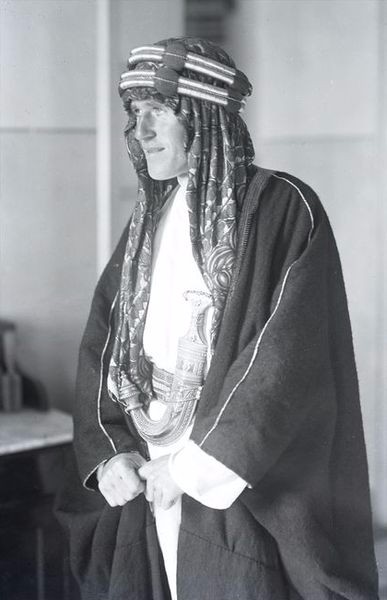
T.East. Lawrence, photograph past Lowell Thomas, 1918: T.E. Lawrence, meliorate known as "Lawrence of Arabia," in Jerusalem upon being introduced at the office of the British armed services governor on February 28, 1918. The photo was taken by Lowell Thomas, an American war contributor and broadcaster whose photos and moving-picture show are credited with making Lawrence famous.
The Austria-hungary besides surrendered in October. The Habsburg royal family unit and the Austro-Hungarian authorities badly sought to keep its domain of diverse nationalities together, just the once-powerful dynastic empire roughshod apart and split into the separate states of Austria, Hungary, Czechoslovakia, and Yugoslavia.
With no ane to stand aslope it, Federal republic of germany surrendered and on Nov 11, 1918, the horrors of World War I finally came to an stop.
Terms and Fallout of Defeat
U.South. President Woodrow Wilson required that Germany acquiesce to the terms of the Fourteen Points, which required the return of territory acquired by the Treaty of Brest-Litovsk to Russia, and the provinces of Alsace and Lorraine to France. Germany considered the terms extremely harsh, while the Allied nations institute them besides lenient. Nonetheless, when Emperor Wilhelm II abdicated the throne, the new German government quickly agreed to Wilson's demands. The details of the agreement were hammered out the following year during the Paris Peace Briefing.

Signing the Treaty of Brest-Litovsk: This photo shows the signing the Treaty of Brest-Litovsk (February 9, 1918). Russia ceded territory to Germany in this treaty, which was reversed with the end of World War I.
By the terminate of the war, at that place were millions of casualties. Many died in battle, while others succumbed to disease and malnutrition resulting from the devastation of their homes and surroundings. Additionally, somewhere between 20 and twoscore million people—more than the number who died in the Groovy State of war itself—were overrun past an flu pandemic known as "Spanish Flu" that spread throughout the globe in 1918–1919. The economical price was incredibly high as a issue of the war, both in the overall shift in production concerns and the impecuniousness of nations denied or stripped of resources, causing widespread starvation throughout Europe during the wintertime of 1918–1919. Many veterans found themselves homeless and jobless upon their return from the battlefields.
Earth War I had touched every aspect of the lives of those who survived to see much of Europe and its territories in ruins.
Wilson'due south Fourteen Points
The Fourteen Points, a speech fabricated by Woodrow Wilson in January 1918 outlining the aims of the Great War, became the pattern for postwar peace negotiations.
Learning Objectives
Summarize the key points made in Woodrow Wilson's Fourteen Points spoken communication, and the reaction of Federal republic of germany, Britain, France, and other nations
Key Takeaways
Key Points
- The 14 Points speech delivered past Woodrow Wilson to a joint session of Congress was meant to assure the country that the Swell State of war was being fought for the moral crusade of postwar peace in Europe.
- Assertive that the Fourteen Points would offering fair terms for peace, the German language Imperial Chancellor Maximilian of Baden requested an armistice in October 1918. The fighting came to an end on November xi, 1918.
- The Fourteen Points were the ground of negotiation betwixt the defeated Central powers and the victorious Allies at the Paris Peace Conference of 1919. Allied leaders were skeptical of Wilsonian idealism, and Britain refused to concur to some of the weather, such as allowing free navigation of the seas, and insisted Germany should pay reparations.
- President Wilson became ill at the beginning of the Paris Peace Conference, allowing French Prime Minister Georges Clemenceau and the other leaders of the "Large Four" to change many of his plans. The concluding peace settlement of the state of war, the Treaty of Versailles, required Germany to pay huge sums for war reparations.
Fundamental Terms
- Treaty of Versailles: 1 of the major peace treaties drafted at the Paris Peace Briefing in 1919. Signed on June 28, 1919, exactly five years after the assassination of Archduke Franz Ferdinand, the treaty ended the state of war betwixt Federal republic of germany and its coalition and the Allied powers led past France, United kingdom of great britain and northern ireland, and the United States.
- Georges Clemenceau: (1841–1929) A French journalist, physician, and statesman who served as the prime number minister of France from 1906 to 1909 and again from 1917 to 1920.
- Paris Peace Conference: A 1919 coming together of the Allied victors and the defeated Central powers to set the terms of the ceasefire ending Earth War I and to establish a postwar peace plan based on U.Due south. President Woodrow Wilson's Fourteen Points.
The Fourteen Points was a spoken language given by U.S. President Woodrow Wilson to a joint session of Congress on January eight, 1918. The address was intended to assure the country that World State of war I, which America had joined on Apr 6, 1917, was being fought for a moral crusade and for a lasting postwar peace in Europe.
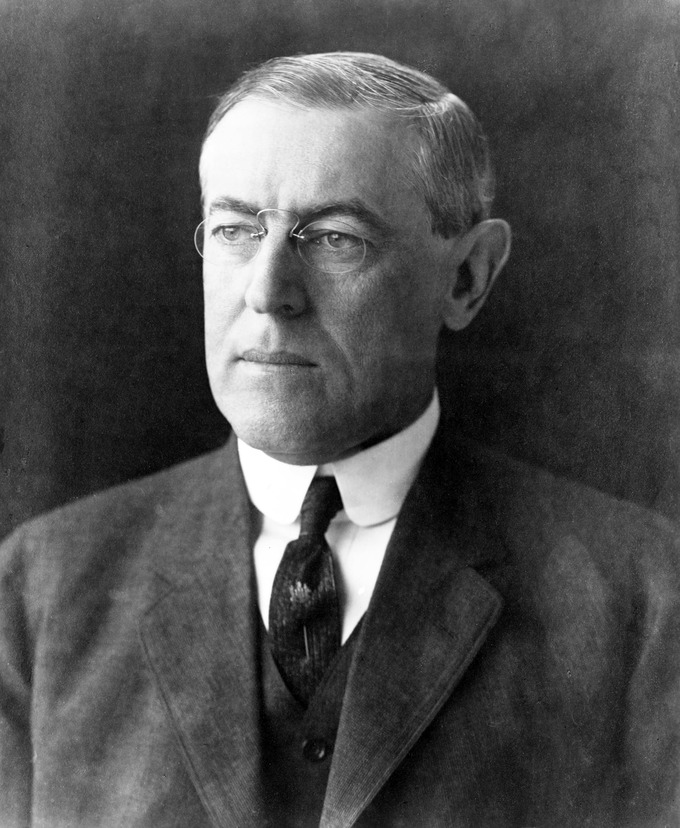
Woodrow Wilson: Woodrow Wilson's Fourteen Points speech outlined his goals for postwar cooperation.
The speech was delivered 10 months before the armistice with Germany in November 1918, and became the basis for the terms of the German surrender, every bit negotiated at the Paris Peace Conference in 1919. Wilson was awarded the 1919 Nobel Peace Prize for his peace-making efforts first envisioned in the spoken communication.
Content of the Voice communication
Some belligerents in the conflict gave full general indications of their aims, but most kept their postwar goals to themselves, making the Fourteen Points spoken communication the only explicit statement of war aims past any of the nations fighting in Globe War I.
Each of the Fourteen Points detailed in the speech was based on research by a squad of almost 150 experts, led past Wilson'due south foreign policy counselor, Edward Grand. Business firm, on the topics nigh probable to arise in the anticipated peace conference at the finish of the war. Wilson's oral communication translated many of the principles of Progressivism that had produced domestic reform in the Usa into foreign policy objectives for all nations, including free trade, open agreements, democracy, and self-determination.
The speech also addressed goals articulated in Vladimir Lenin 's Decree on Peace of October 1917, including a only and autonomous peace uncompromised by territorial annexations. The decree led to the March 3, 1918, signing of the Treaty of Brest-Litovsk, nether which Russia immediately withdrew from the war.
The Fourteen Points could exist simplified to a cadre list of agreements and goals for all participating nations:
- No surreptitious alliances betwixt countries
- Freedom of the seas in peace and war
- Reduced trade barriers among nations
- General reduction of armaments
- Adjustment of colonial claims in the interests of inhabitants also as the colonial powers
- Evacuation of Russian territory and a welcome for its government to the order of nations
- Restoration of Belgian territories in Germany
- Evacuation of all French territory, including Alsace-Lorraine
- Readjustment of Italian boundaries along clearly recognizable lines of nationality
- Independence for various national groups in Austria-Hungary
- Restoration of the Balkan nations and free access to the body of water for Serbia
- Protection for minorities in Turkey and the free passage of the ships of all nations through the Dardanelles
- Independence for Poland, including admission to the sea
- Establishment of a League of Nations to protect, "mutual guarantees of political independence and territorial integrity to corking and small nations alike"
International Reaction
The speech was widely disseminated as an instrument of propaganda to encourage the Allies to victory. Copies were dropped behind German lines to encourage the Central powers to surrender in the expectation of a but settlement and, indeed, that was the result: a note sent to Wilson by German Imperial Chancellor Maximilian of Baden in October 1918 requested an immediate armistice and peace negotiations on the basis of the Fourteen Points.
The speech was fabricated without prior coordination or consultation with Wilson'south counterparts in Europe and was the only public statement of war aims made by any of the combatants. This made it the centerpiece of the long debates over an equitable peace settlement and treaty terms that came later on.
The Fourteen Points versus the Treaty of Versailles
The Fourteen Points were accepted by French republic and Italy on November i, 1918. Britain later signed off on all of the points except the freedom of the seas. The United Kingdom also wanted Germany to make reparation payments for the war and believed that condition should be included in the Fourteen Points.

Georges Clemenceau: Georges Clemenceau (September 28, 1841–November 24, 1929) served as the prime government minister of France and was one of the principal architects of the Treaty of Versailles.
President Wilson became sick at the onset of the Paris Peace Briefing, which began on Jan xviii, 1919, at the Palace of Versailles approximately 12 miles from Paris. Wilson's illness enabled the right-wing French Chancellor Georges Clemenceau to pb the other two members of the "Large Four" powers—British Prime Minister David Lloyd George and Italian Premier Vittorio Orlando—in changing many aspects of Wilson'south program.
The most controversial alteration was that Germany received the arraign for the whole war and was required to pay an astronomical sum in war reparations, including bounty for the impairment inflicted on the territories its military occupied and funding for the pensions of wounded Centrolineal soldiers and widows. Germany was likewise denied an air forcefulness, and the High german ground forces was not to exceed 100,000 men.
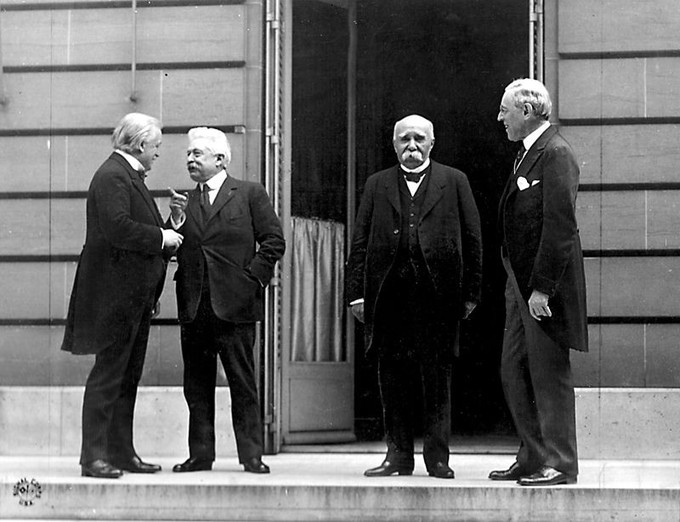
Large Iv of Globe State of war I: This photograph shows the leaders of the "Big Iv" Centrolineal powers at the Paris Peace Conference, May 27, 1919. From left to correct, British Prime Minister David Lloyd George, Italian Premier Vittorio Orlando, French Premier Georges Clemenceau, and U.South. President Woodrow Wilson.
The deviation between President Wilson's comparably honorable peace offer toward the German Empire, which was far less harsh than the demanded pause up of the Austro-Hungarian Empire, and the terms laid out in the final version of the Treaty of Versailles led to great acrimony in Germany. The treaty came to be known at that place as, "the stab in the dorsum," a major propaganda slogan used in the years that followed by embittered German nationalists and ultimately the Nazi Party. The Treaty of Versailles had footling to do with the Fourteen Points and was never ratified by the U.S. Senate
The Paris Peace Conference
The Paris Peace Conference adamant the terms of peace after Globe War I between the victorious Allies and the defeated Central powers.
Learning Objectives
Analyze the contentious negotiations between the United States, United kingdom of great britain and northern ireland, and France at the Paris Peace Conference
Key Takeaways
Key Points
- The Paris Peace Conference, led by the leaders of France, the Great britain, Italy, and the United States, prepare peace terms with the defeated Central powers that reshaped the map of Europe. The peace conference resulted in the Treaty of Versailles, which contained a punitive state of war-guilt clause declaring Germany guilty of initiating the war, requiring the German regime to pay the cost of the war to the victors, and severely crippling the High german military. The treaty besides disbanded the Austria-hungary.
- Woodrow Wilson wanted to evangelize on the hope of the Fourteen Points and actively intervened in the Paris Peace talks, leading U.Due south. foreign policy toward interventionism. France and Britain refused to take some of the Fourteen Points, although they agreed to the creation of a League of Nations.
- The U.S. Congress never ratified the Treaty of Versailles, signing a separate peace agreement with Germany in 1921, and the United States did not join the League of Nations Wilson had envisioned.
Key Terms
- Sykes-Picot Agreement: A cloak-and-dagger pact, signed in 1916, between the governments of the U.k. and French republic with the assent of Russia, defining their proposed spheres of influence and control of the Middle Due east should the Central powers be defeated in World War I.
- Fourteen Points: A speech given past President Woodrow Wilson to a articulation session of Congress on January viii, 1918. The accost was intended to clinch the country that the Great War was existence fought for a moral crusade and for postwar peace in Europe.
- League of Nations: An international organization founded as a result of the Treaty of Versailles, which concluded the World War I. Proposed by Woodrow Wilson, its goals included disarmament, preventing war through collective security, settling international disputes through negotiation, affairs, and improving global quality of life. The Us never joined because Congress refused to ratify the Treaty of Versailles.
Following the Allied victory, President Woodrow Wilson met with his counterparts, Prime Minister David Lloyd George of Dandy United kingdom and Prime Minister Georges Clemenceau of France, at the Paris Peace Conference of 1919. These leaders largely prepare the peace terms for the defeated Central powers, reshaping the map of Europe through territorial expansions and losses that favored the victors. While the conference should have been considered a victory for Wilson, whose envisioned League of Nations was established, the U.S. Congress refused to accept the terms of the briefing's cornerstone piece of work, the Treaty of Versailles.
Negotiating the Peace
Germany and Communist Russia were not invited to attend negotiations at the conference, but numerous other nations sent delegations, each with a different agenda. For six months, Paris was effectively the center of a world authorities as the peacemakers dealt with broke empires and created new countries.
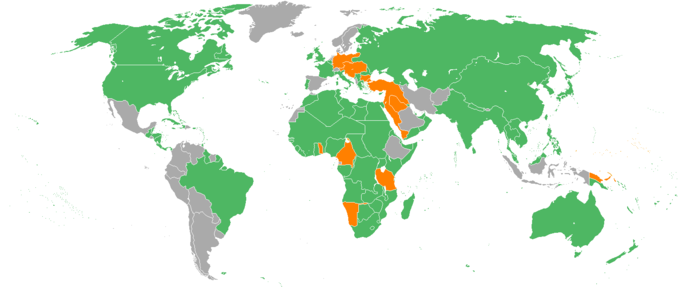
Participant countries in Earth State of war I: This map of the globe shows participants in World War I. The Allies are depicted in greenish, the Cardinal powers in orange, and neutral countries in grey. World War I involved well-nigh of the world, and afterward peace negotiations did besides.
The near contentious issue of the Paris Peace Briefing was a castigating peace accord, the Treaty of Versailles, which included a "state of war-guilt clause" laying blame for the outbreak of war on Deutschland and, as penalization, weakening its military and requiring it to pay all war costs of the victorious nations. Also equally a upshot of the conference's postwar settlements, the Austria-hungary ceased to exist and new, self-governing states were created for its disparate ethnic peoples.
Failure to Adopt the Fourteen Points
The Fourteen Points Wilson proffered in a 1918 speech to the U.Due south. Congress had helped win the hearts and minds of Americans and Europeans, including Deutschland and its allies, and his affairs essentially established the weather condition for the armistices that brought the war to an stop. No American president had ever visited Europe while in part, but Wilson believed it was his duty to be a prominent effigy at the peace negotiations, with high hopes and expectations placed on him to deliver what he had promised for the postwar era. In doing so, Wilson was ultimately leading U.S. strange policy toward interventionism, a motility strongly resisted in some domestic circles.
Upon his arrival at the conference, Wilson worked to influence the direction that the French delegation led by Clemenceau and the British under Lloyd George took toward Germany and its fallen allies, besides equally the former Ottoman lands in the Eye East. Notwithstanding Wilson's attempts to gain acceptance of his Xiv Points ultimately failed later French republic and Britain refused to adopt some specific points and its cadre principles, although they tried to appease the American president past consenting to the institution of his League of Nations. Several of the Fourteen Points conflicted with other European powers, too.
The United States did non believe responsibility for the war or the war-guilt clause placed on Germany was off-white or warranted. It would not be until 1921, under President Warren Harding, that the U.s. finally signed separate peace treaties with Germany, Republic of austria, and Hungary.
The states Rejects Treaty
The Republican Party, led by Henry Cabot Lodge, controlled the U.S. Senate after the election of 1918, but its members were divided into multiple positions on the Versailles question. Information technology proved possible to build a majority coalition, simply they could not attain the two-thirds majority needed to pass the treaty. Among the American public, Irish-Catholics and German-Americans were intensely opposed to the treaty, challenge that information technology favored the British.
An angry bloc in the Senate of 12 to 18 " Irreconcilables "—mostly Republicans, but also representatives of the Irish and German Democrats—fiercely opposed the treaty. One bloc of Democrats strongly supported the Versailles Treaty, even with reservations added by Lodge. A second group of Democrats supported the treaty but followed Wilson in opposing any amendments or reservations. The largest bloc, led by Lodge, comprised a majority of the Republicans who wanted a treaty with reservations, especially on Article X, which involved the power of the League of Nations to make war without a vote by the U.Southward. Congress. All of the Irreconcilables were bitter enemies of President Wilson, and he launched a nationwide speaking bout in the summer of 1919 to refute them. However, Wilson complanate midway through the tour with a serious stroke that finer ruined his leadership skills.
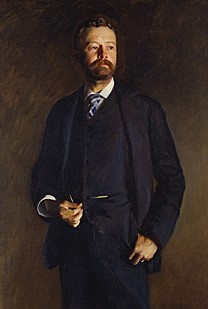
Henry Cabot Lodge: Senator Henry Cabot Lodge led the Irreconcilables, who blocked approval of the Treaty of Versailles in the U.Southward. Congress.
The closest the treaty came to passage in Congress was on November nineteen, 1919, equally Order and his fellow Republicans formed a coalition with pro-treaty Democrats and were close to a two-thirds majority for a treaty with reservations. Wilson rejected this compromise, all the same, and plenty Democrats followed his atomic number 82 to permanently terminate chances for ratification. During this flow, Wilson became less trusting of the press and stopped holding press conferences, preferring to employ his propaganda unit, the Commission for Public Information. A poll of historians in 2006 cited Wilson's failure to compromise with the Republicans on U.S. entry into the league every bit one of the 10 biggest errors past an American president.
Wilson's successor, President Warren G. Harding, continued American opposition to the League of Nations. Information technology was non until July 21, 1921, that Harding signed into constabulary the Knox-Porter Resolution drafted by Congress, which formally concluded hostilities between the U.s.a. and the Fundamental Powers.
Mail service-WWI Territorial Changes
The Treaty of Versailles included a number of territorial changes including Germany's forced return of territories in Europe and yield of control over its colonies. The province of West Prussia was ceded to the restored Poland, granting information technology access to the Baltic Sea and turning East Prussia into an exclave separated from mainland Federal republic of germany.
The major territorial changes included the post-obit:
- After approximately 200 years of French rule, Alsace and the German language-speaking role of Lorraine were ceded to Germany in 1871. In 1919, these regions returned to French republic.
- Most Prussian provinces were ceded to Poland.
- New territories were transferred to Czechoslovakia, Poland, and Belgium.
- Germany lost Kaliningrad, a strategically important port on the Baltic Sea.
- Republic of austria was forbidden from integrating with or into Germany.
- German colonies were divided between Belgium, Bully Uk and certain British Dominions, France, and Nihon.
- In Africa, Britain and France divided German Kamerun (Cameroons) and Togoland. Belgium and the Great britain gained territory in German E Africa, and Portugal received a sliver of High german East Africa. German South Westward Africa was mandated to the Marriage of South Africa.
- In the Pacific, Japan gained Deutschland's islands due north of the equator (the Marshall islands, the Carolines, the Marianas, and the Palau Islands) and Kiautschou in Communist china. German Samoa was assigned to New Zealand while German language New Republic of guinea, the Bismarck Archipelago, and Republic of nauru were assigned to Australia.
Negotiations in the Center East
In the Eye Due east, negotiations were complicated by competing aims, claims, and the new mandate system. The Us hoped to institute a more liberal and diplomatic world, as stated in the Fourteen Points, where commonwealth, sovereignty, freedom, and self-conclusion would be respected. France and Great britain, on the other hand, already controlled empires, wielded power over subjects around the world, and aspired to exist dominant colonial powers.
In calorie-free of the previously secret Sykes-Picot Agreement, a 1916 treaty regarding European spheres of influence in the regions, and following the adoption of the mandate system on the Arab province of the onetime Ottoman lands, the conference heard statements from competing Zionist and Arab claimants. President Wilson recommended an international commission of inquiry to ascertain the wishes of the local inhabitants. Eventually it became the purely American Rex-Crane Committee, an investigatory commission that toured all of Syrian arab republic and Palestine during the summer of 1919, taking statements and sampling opinions. Its report, presented to President Wilson, was kept secret from the public until The New York Times broke the story in December 1922, although a pro-Zionist joint resolution on Palestine was passed by Congress in September 1922.
The League of Nations
The League of Nations, created by the Treaty of Versailles following Earth State of war I, was an organization formed to promote diplomacy and preserve earth peace.
Learning Objectives
Identify the creation, goals, and limitations of the League of Nations
Primal Takeaways
Primal Points
- Originally envisioned in Woodrow Wilson 's 14 Points, the League of Nations sought to prevent wars through commonage security and mutual disarmament, and by settling disputes through international negotiation and mediation.
- The league lacked its own armed forces and depended on utilizing the military strength of member nations, which most of the great powers were reluctant to do. The league was unable to forbid assailment by the Axis powers in the 1930s or forestall Germany, Japan, Italian republic, and Kingdom of spain from withdrawing membership.
- Several primal nations did not take roles in the league. Soviet Russian federation never entered the league, and Germany was not allowed to join until 1926. Despite President Wilson's vigorous entrada for American support, Republicans refused to support either the Care for of Versailles or the league. The United States never ratified the treaty and was therefore excluded from any league activities.
Key Terms
- Fourteen Points: A spoken communication given by U.S. President Woodrow Wilson to a joint session of Congress on January 8, 1918. The address was intended to clinch the state that the Great State of war was being fought for a moral crusade and to outline a postwar design for global peace.
- Treaty of Versailles: One of the peace treaties at the cease of World War I that ended the state of war between Deutschland and the Allied powers. Information technology was signed on June 28, 1919, exactly five years later the assassination of Archduke Franz Ferdinand.
- Paris Peace Conference: The meeting of the Centrolineal victors following the end of World State of war I to set the peace terms for the defeated Central powers post-obit the armistice of 1918.
The League of Nations was an international, governmental organization founded through negotiations at the Paris Peace Conference of 1919, which officially brought an end to the Commencement World State of war. The league was the abstraction of U.S. President Woodrow Wilson, who starting time unveiled the thought in his famed speech to Congress on January 18, 1918, outlining the Fourteen Points, his pattern for global postwar peace and diplomacy.
The league was the first permanent international organization whose master mission was to maintain world peace. Its primary goals included preventing wars through commonage security and disarmament, and settling international disputes through negotiation and arbitration. It also indirectly addressed labor conditions, but treatment of native inhabitants, human and drug trafficking, artillery trade, global health, prisoners of war, and protection of minorities in Europe. At its largest, from September 1934 to Feb 1935, the league counted 58 nations as members.
While its philosophy and diplomatic aims were groundbreaking, the league never reached its full potential largely due to a lack of participation by cardinal international players, notably Russian and the U.s..
League Philosophy
The diplomatic philosophy behind the League of Nations represented a cardinal shift from the preceding hundred years. The league lacked its own military and depended on the traditional Nifty Powers nations—France, United kingdom of great britain and northern ireland, Russia, Germany, and Japan—to enforce its resolutions, maintain its economic sanctions, or provide military support when needed. Nevertheless the Not bad Powers were oftentimes reluctant to practise and so considering of concerns about weakening their individual strength and using resource outside their borders.
Subsequently a number of notable successes and some early failures in the 1920s, the league ultimately proved incapable of preventing aggression by the Centrality powers in the 1930s. Germany withdrew from the league, as did Japan, Italy, Spain, and others. The onset of Earth War II proved that the league had failed its principal purpose, which was to prevent another world disharmonize.
Creating the League
By the fourth dimension the fighting ended in Nov 1918, World War I had leveled a profound blow, affecting the social, political, and economical systems of Europe and its colonies and inflicting psychological and physical damage. Antiwar sentiment rose across the globe following Earth War I, which was described equally, "the war to end all wars." The war was ultimately blamed on international arms races, alliances, secret affairs, and the freedom of sovereign states to enter into war for their own benefit.
One proposed remedy to this sort of damaging international affairs was the creation of an organization whose aim was to forbid future wars through disarmament, open diplomacy, international cooperation, restrictions on the correct to wage state of war, and penalties that made war unattractive. Wilson and his adviser, Colonel Edward M. House, enthusiastically promoted the idea of the league as a ways of fugitive whatsoever repetition of the bloodshed of Globe War I, and the cosmos of the league became the centerpiece of Wilson'due south Fourteen Points for Peace.
The Paris Peace Conference canonical the proposal to create the League of Nations in January 1919, and the league was established past Part I of the Treaty of Versailles. In June 1919, 44 states signed the league'due south covenant.

Failure of the League: While 1 of the primary goals of the League of Nations was global diplomacy, the league proved largely unsuccessful in part because it lacked the support of the United States.
The league held its first council coming together in Paris in Jan 1920, six days later the Care for of Versailles came into force. The aftermath of World War I left many issues to be settled, including the verbal position of national boundaries and which country particular regions would join. Most of these questions were handled by the victorious Centrolineal powers, and subsequently the league played little part in resolving the turmoil resulting from the war.
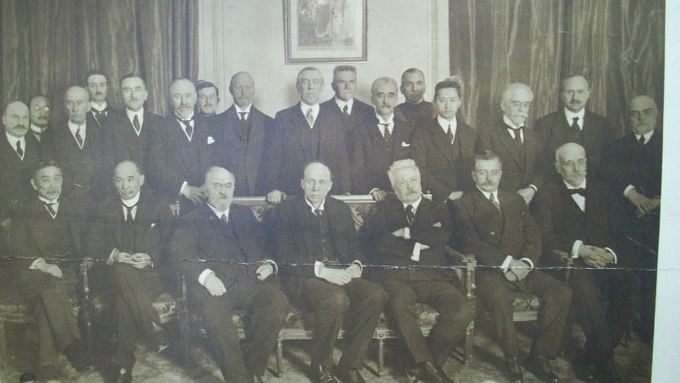
League of Nations Committee: Members of the Committee of the League of Nations in Paris, France, 1919.
League Weaknesses
The league's major weaknesses can exist summed upwards in 3 categories: Representation, collective security, and enforcement.
Representation at the league was oftentimes a problem. Though it was intended to encompass all nations, many never joined, or their time every bit part of the league was brusque. The most conspicuous absence was the U.s.. When the league was born in January 1920, neither Federal republic of germany nor Russia was permitted to join. The league was farther weakened when major powers, such as Japan and Italy, left in the 1930s.
The second of import weakness grew from the contradiction between the thought of collective security that formed the basis of the league and international relations betwixt individual states. The league's commonage security organization required nations to act, if necessary, against states they considered friendly, and in a way that might endanger their national interests, to support states for which they had no normal affinity.
Finally, the League of Nations lacked whatever type of military of its own and depended on the Great Powers to enforce its resolutions, which they were unwilling to exercise. Its two nigh of import members, Britain and France, were reluctant to use sanctions and even more reluctant to resort to military action on behalf of the league as pacifism had get a stiff strength among the people and the leaders of the two countries in the aftermath of Globe War I.
The United States Rejects the League
Despite Wilson'southward efforts to plant and promote the organization, for which he was awarded the 1919 Nobel Peace Prize (bestowed in 1920) in recognition of his work every bit the "Father of the League of Nations," the Usa did not bring together the league due to opposition from Republicans in the Senate. The ii-thirds bulk needed to laissez passer the treaty was not obtained.
The Republican Party, led past Henry Cabot Guild, controlled the U.S. Senate after the election of 1918, just its members were divided into multiple positions on the Treaty of Versailles and, subsequently, the League of Nations. Among the American public, Irish gaelic Catholics and German Americans were intensely opposed to the treaty, claiming it favored the British.
An angry bloc in the Senate of 12 to 18 " Irreconcilables "—mostly Republicans, but as well representatives of the Irish and German Democrats—fiercely opposed the treaty. Ane bloc of Democrats strongly supported the Treaty of Versailles, even with reservations added by Lodge. A second group of Democrats supported the treaty but followed Wilson in opposing any amendments or reservations.
The largest bloc, led by Lodge, wanted a treaty with reservations, specially on Article X, which involved the ability of the League of Nations to make war without a vote past the U.South. Congress. The Irreconcilables were bitter enemies of President Wilson, and he launched a nationwide speaking tour in the summer of 1919 to refute them. However, Wilson collapsed midway through the tour with a serious stroke that finer ruined his leadership abilities.
Wilson'due south successor, President Warren Thou. Harding, continued American opposition to the League of Nations. It was non until July 21, 1921, that Harding signed into police the Knox-Porter Resolution drafted by Congress, which formally ended hostilities betwixt the United States and the Central powers.
The Usa was the just major power to emerge from Earth War I in a position of relative economical strength, putting America in the all-time position to intervene in international disagreements with potential for state of war. Therefore, the U.S. refusal to ratify the Treaty of Versailles and to join the league had global consequences in terms of the financing and enforcement America could accept brought to affect league diplomacy.
The irony of the large, wealthy nation whose president first proposed the league failing to join its ranks was not lost on other countries and was a major reason the league did not become the peachy diplomatic clearing house Wilson envisioned. The league cannot exist labeled a failure, however, as information technology laid the groundwork for the United nations, which replaced the League of Nations after World State of war II and inherited a number of agencies and organizations founded by the league.
Source: https://courses.lumenlearning.com/boundless-ushistory/chapter/diplomacy-and-negotiations-at-the-end-of-the-war/
0 Response to "What Did the Allies Hope to Gain in Negotiating the 1919 Peace Treaty in Paris?"
Post a Comment