explain what is unique about thyroid hormones with regard to their chemical composition
Where is my thyroid gland?
The thyroid gland is located at the forepart of the cervix but below the Adam's apple (larynx). Information technology is butterfly-shaped and consists of ii lobes located either side of the windpipe (trachea). A normal thyroid gland is not usually outwardly visible or able to be felt if finger pressure is applied to the cervix.
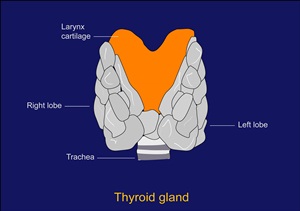
Diagram showing the location of the thyroid gland in the neck. It has ii lobes and sits in front of the windpipe (trachea). The phonation box (larynx) sits just in a higher place the thyroid.
What does the thyroid gland do?
The thyroid gland produces hormones that regulate the trunk'smetabolic rate controlling heart, muscle and digestive office, brain development and bone maintenance. Its correct functioning depends on a skillful supply of iodine from the nutrition. Cells producing thyroid hormones are very specialised in extracting and arresting iodine from the blood and incorporate it into the thyroid hormones.
Who tells the thyroid to produce and release hormones?
The signal comes from a small gland located at the bottom of our encephalon called the pituitary gland . The pituitary gland produces and sends out a hormone called thyroid-stimulating hormone (TSH). TSH then tells the thyroid gland how much hormones to produce and secrete. TSH levels in your blood are rising and falling depending on your torso's needs to produce more or less thyroid hormones.
In that location is a tertiary histrion involved in this communication. The pituitary gland responds either directly to the thyroid hormones in the claret, simply it also responds to signals from the hypothalamus , which sits above the pituitary gland as function of your brain. The hypothalamus releases its ain hormone thyrotropin-releasing hormone (TRH). TRH in turn stimulates the release of TSH in the pituitary, which and then signals to the thyroid gland.
This whole network is also referred to as the hypothalamic-pituitary-thyroid axis (HPT) and it adapts to metabolic changes and your body'south needs.
Which hormones does my thyroid gland produce?
The thyroid gland produces thyroxine (referred to every bit T4), which is a relatively inactive prohormone. The highly agile hormone is triiodothyronine (referred to every bit T3). Collectively, thyroxine and triiodothyronine are referred to as the thyroid hormones. The thyroid gland produces simply 20% of the loftier active T3, merely it produces fourscore% of the prohormone T4. Once secreted by the thyroid, specific enzymes in other tissues similar the liver or kidneys may transform T4 in to the active hormone T3.
In add-on, in that location are other hormone-producing cells within the thyroid gland called C-cells. These cells producecalcitonin. Calcitonin plays a office in regulating calcium and phosphate levels in the claret, which is important for your bone wellness and maintenance.
What could become wrong with the thyroid gland?
Normally the thyroid gland produces the exact number of hormones needed to keep your body's metabolism running and in balance. Equally described earlier, hormones secreted by the pituitary gland (TSH) stay constant in your blood circulation, but their levels may increase or decrease when T4 levels in the blood are irresolute. This hypothalamic-pituitary-thyroid feedback loop keeps the levels of T4 in your claret stable and reacts to pocket-size changes immediately.
However, there are several disorders associated with the thyroid gland with almost problems concerning the production of thyroid hormones. Either the thyroid gland produces likewise much hormone (called hyperthyroidism) or your thyroid doesn't produce plenty hormone (called hypothyroidism), resulting in your trunk using energy faster or slower than it should.
What are typical symptoms of hyper- and hypothyroidism?
Typical symptoms for hyperthyroidism is weight loss, fast centre rate, high irritability/nervousness, musculus weakness and tremors, infrequent menstrual periods, sleep problems, middle irritations and heat sensitivity.
Symptoms for hypothyroidism is the contrary of hyperthyroidism such as weight gain, slower heart rate, fatigue, more frequent and stronger menstrual periods, forgetfulness, dry skin and hair, hoarse voice and intolerance to common cold. In addition, hypothyroidism is often accompanied by an enlargement of the thyroid gland known as goitre.
Who is affected past thyroid disease?
On a worldwide scale, approximately 200 million people take some form of thyroid disease. People of all ages and races can get thyroid disease. However, women are five to 8 times more likely than men to get problems with their thyroid function.
What causes thyroid affliction?
There are various unlike factors causing hyper- and hypothyroidism.
The post-obit weather condition cause hypothyroidism:
Thyroiditis is an inflammation of the thyroid gland. This tin can lower the number of hormones produced.
A special form of thyroiditis is Hashimoto's thyroiditis. This is a genetic disorder caused by diseases of the immune organization and tin be passed from one generation to the other. In addition, thyroiditis can occur in women subsequently giving birth also referred to as postpartum thyroiditis. It is usually a temporary condition and occurs only in 5-ix% of adult female giving birth.
Nutrition also impacts your thyroid functions. Iodine deficiency tin can cause hypothyroidism. This is a worldwide problem affecting approximately 100 meg people. As mentioned earlier, iodine is used by the thyroid gland to produce hormones.
The following conditions cause hyperthyroidism:
Graves' disease is a condition where the entire thyroid gland might exist overactive and produce too much hormone. Your thyroid gland might exist enlarged. This problem is also called diffuse toxic goitre.
Thyroiditis (inflammation) tin also cause the opposite and trigger the release of hormones that were stored in the thyroid gland. This uncontrolled release of thyroid hormones causes hyperthyroidism for a few weeks or months. It may occur in women after childbirth.
In contrast to iodine deficiency, excessive iodine intake may take negative effects on your thyroid. Excessive iodine is found in a number of drugs such equally Amiodarone, Lugol's solution (iodine) and some cough syrups. This might cause the thyroid to produce either besides much or too niggling hormone in some individuals.
The before mentioned problems bear upon the production of thyroid hormone (either besides much or likewise little). All the same, issues concerning the thyroid gland can be very distinct. Swelling and lumps can occur within the thyroid gland. Such nodules can be harmless, but some tin cause the product of hormones or fifty-fifty be cancerous. In some cases, such equally cancer, the thyroid is removed. You lot can live without your thyroid, merely you need to take medicine daily to substitute the hormones produced by your thyroid gland.
How can I promote the health of the thyroid gland?
Iodine is most essential to maintain a healthy thyroid. Iodine is the critical 'ingredient' for the product of thyroid hormones. We don't demand a lot of iodine, it is said that "one teaspoon of iodine is enough for a lifetime". Nonetheless, the daily and constant supply of this micronutrient is of import. Too much iodine at in one case is counter-productive and causes your thyroid to produce less hormones. The best mode to get your daily dose of iodine is through eating healthy foods like seafood and dairy products. In addition, iodized salt is a practiced source and y'all tin can use it to flavour your food. Present, iodine is added to table salt to combat goitres (caused past hypothyroidism).
Last reviewed: Mar 2018
Source: https://www.yourhormones.info/glands/thyroid-gland/
0 Response to "explain what is unique about thyroid hormones with regard to their chemical composition"
Post a Comment